
NIKA
Transfiguration / Trasfigurazione, artista nata a San Pietroburgo, NIKA, residente in Germania, la sua formazione artistica è l’America, la cui ricerca si sviluppa come un ponte tra la rigorosa tradizione dei grandi maestri e una visionaria sensibilità contemporanea.
In un linguaggio sospeso tra simbolismo, realismo magico e suggestioni della mitologia classica, l’artista costruisce immagini nelle quali la memoria della storia dell’arte dialoga con una dimensione profondamente interiore. Nella sua pittura convivono l’equilibrio compositivo e la sensibilità materica, il rigore della tradizione rinascimentale e una visione capace di oltrepassare il dato reale per accedere a una dimensione più intima e misteriosa.
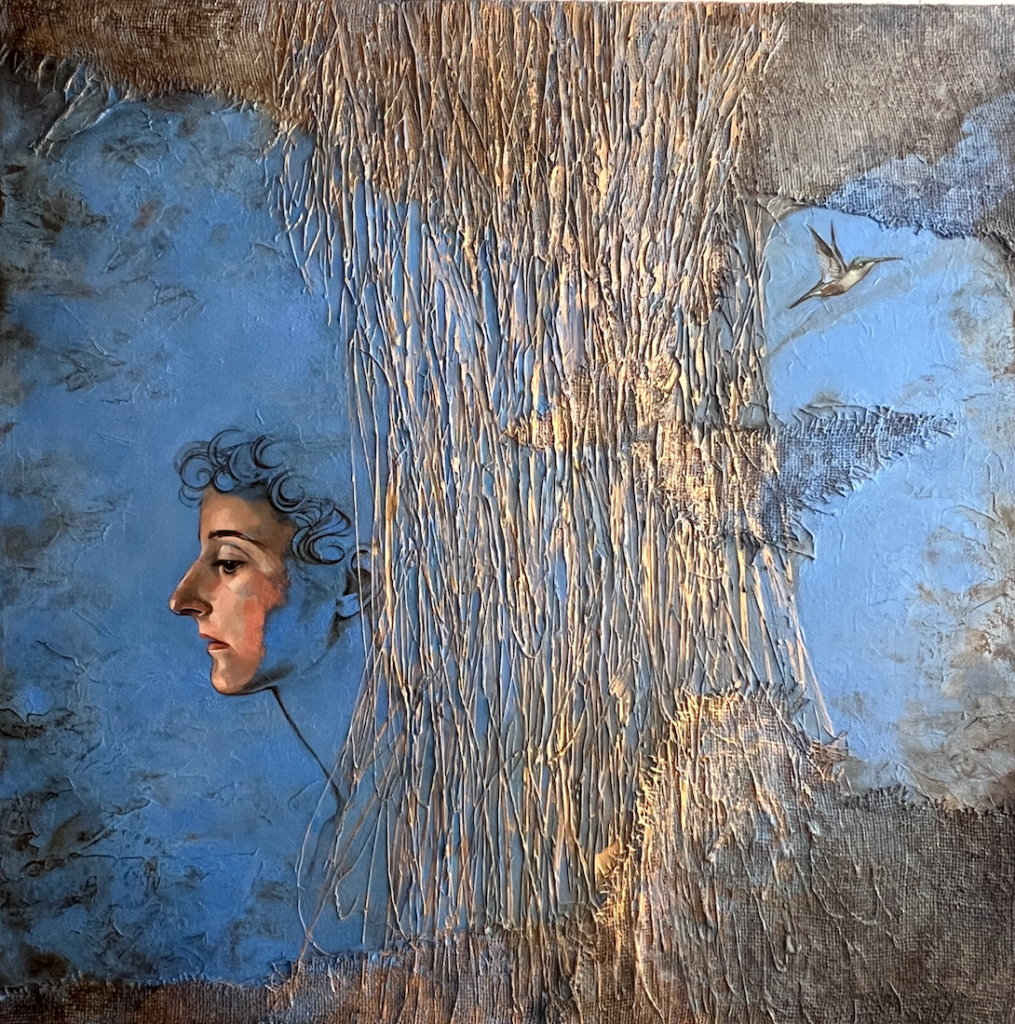
Transfiguration appare come un’immagine evocativa e, al tempo stesso, come la rappresentazione di uno spazio interiore. Il soggetto sembra emergere da un mondo sospeso, separato dalla realtà circostante attraverso una particolare relazione tra toni blu e presenze dorate, dove la materia pittorica assume una funzione quasi simbolica. L’oro, prezioso e luminoso, non è soltanto elemento decorativo, ma sembra custodire e delimitare lo spazio dell’immagine, creando una sorta di soglia tra ciò che appartiene al mondo visibile e ciò che invece nasce dalla dimensione interiore.
È proprio questa separazione a conferire all’opera una particolare intensità: una realtà altra, quasi protetta, nella quale l’immagine sembra trovare rifugio. Il blu diviene così uno spazio mentale e contemplativo, mentre la materia dorata introduce una dimensione sacrale, richiamando la tradizione delle icone, della pittura antica e dei grandi maestri del Rinascimento, ma reinterpretandola attraverso una sensibilità pienamente contemporanea.
La trasfigurazione evocata dal titolo non riguarda quindi soltanto la figura rappresentata, ma il processo stesso attraverso il quale la realtà viene trasformata dalla percezione e dall’immaginazione. L’artista conduce lo spettatore oltre la superficie dell’immagine, verso un luogo in cui memoria, mito, simbolo e esperienza personale si sovrappongono.
NIKA rivela nelle sue opere una solida padronanza tecnica, accompagnata da una ricerca estetica orientata verso il classicismo. La sua formazione riflette questo rapporto privilegiato con la storia dell’arte: si è specializzata presso il Museo Statale di San Pietroburgo, proseguendo successivamente gli studi a New York, Washington e presso l’Università delle Arti di Berlino.
La sua pittura nasce dunque dall’incontro fra discipline, luoghi e tradizioni differenti. Il passato non viene citato semplicemente come modello, ma trasformato in un linguaggio vivo, capace di interrogare il presente. In Transfiguration, la tradizione diventa così materia di una nuova visione: un territorio intermedio tra realtà e mito, tra memoria e sogno, nel quale l’immagine sembra custodire, più che rivelare, il proprio segreto.
Transfiguration / Trasfigurazione
Oil on linen, mixed media, 110 × 110 cm
Transfiguration, a work by the artist NIKA. Born in St. Petersburg and shaped by an artistic journey that led her to live between San Francisco and Berlin, her research bridges the rigorous tradition of the Old Masters with a visionary contemporary sensibility.
Transfiguration appears as an evocative image and, simultaneously, as the representation of an inner sanctuary. The subject seems to emerge from a suspended world, separated from the surrounding reality through a deliberate dialogue between blue tones and gilded presences, where the painted medium takes on an almost symbolic function. The gold—precious and luminous—is not merely decorative; it safeguards and defines the boundary of the image, creating a threshold between the visible world and that which arises from within.
It is precisely this separation that imparts a singular intensity to the work: an alternate, almost protected reality in which the image finds refuge. Blue thus becomes a mental and contemplative space, while the gold introduces a sacred dimension—recalling the tradition of icons, ancient painting, and the Renaissance masters, yet reinterpreting it through a thoroughly contemporary lens.
The transfiguration evoked by the title does not merely concern the represented figure, but the very process through which reality is transformed by perception and imagination. The artist guides the viewer beyond the surface of the image, toward a place where memory, myth, symbol, and personal experience overlap.
In her works, NIKA reveals a masterly technical command accompanied by an aesthetic research oriented toward classicism. Her background reflects this privileged relationship with art history: she spent her early formative years at the Hermitage, where her father worked as a historical architect and where she studied art history. She subsequently continued her artistic studies in San Francisco, earning a BFA from the California College of Arts & Crafts (CCAC), before self-directing an in-depth study of Old Masters’ techniques in New York and Washington. Later, she received an MFA from the University of the Arts Berlin (UdK).
Her painting is thus born from the encounter of different disciplines, places, and traditions. The past is not cited simply as a model, but transformed into a living language capable of questioning the present. In Transfiguration, tradition becomes the material for a new vision: an intermediate territory between reality and myth, memory and dream, in which the image seems to safeguard—rather than merely reveal—its secret.